Freenode vs Libera.Chat: how the largest IRC network destroyed itself in 2021
Updated June 28, 2026
For two decades, Freenode and "open-source IRC" were the same sentence. If a project had a channel, it was on Freenode. At its 2016 peak the network carried around 90,000 concurrent users across 40,000-plus channels — the largest IRC network in the world, and the closest thing the free-software movement had to a town square. (For how it got there, and where it sits in the wider arc of IRC's history, start with the timeline.)
In the spring of 2021 it fell apart in about three weeks.
This is the full version of what happened, because the short version ("ownership dispute, everyone left") loses the part that actually matters: how quickly tens of thousands of communities walked, and why they could. If you're just here because an old README points you at Freenode, skip to what it means for you.
The setup: who owned what
Freenode the network was always run by volunteers, on donated servers. But Freenode the legal entity had drifted somewhere else.
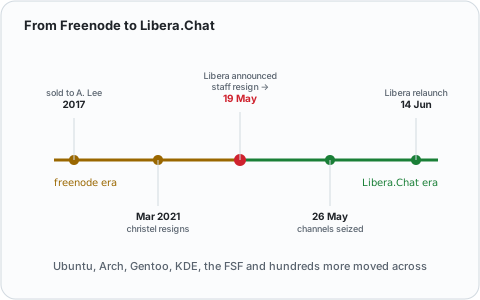
The story has its roots in 2006, when project founder Rob Levin ("lilo") died in a traffic accident and the network passed to long-time staffer Christel Dahlskjaer ("christel"). In 2016 she incorporated Freenode Limited, a holding company. In 2017 that company was sold to Andrew Lee ("rasengan") — entrepreneur, founder of the VPN provider Private Internet Access, and, by his own description, a crown prince of the Korean Imperial Family.
The crucial detail: the terms of that sale were not disclosed to the volunteer staff, who were assured it changed nothing operational. As staff understood it, Freenode Ltd existed to handle finances for the Freenode #live conferences — nothing more. It owned no servers, employed no one, and had no hand in running the network. Lee, at the time, promised never to exercise operational control.
For four years, that held.
The unravelling: a three-week timeline
It came apart fast once it started. The sequence, as reconstructed from staff resignation letters, Lee's own statements, and contemporaneous reporting by LWN and The Register:
- February 2021 — The logo of Shells, another company Lee co-founded, appears on the Freenode front page. Staff weren't consulted; it caused months of confusion about how to answer users asking what it was.
- March 2021 — Rather than keep explaining the Shells situation, christel resigns. Staff elect Tom Wesley ("tomaw") as the new head of staff.
- 3 April 2021 — tomaw asks Lee whether he can hold the domain. Lee wants to discuss it. A few days later Lee finds he's been locked out of DNS access and asks for it back, or at least access for his admin. tomaw refuses.
- 18 April 2021 — Staff publish a blog post on organisational restructuring: a new team, a switch of server software, and a partnership with OFTC.
- 11 May 2021 — Lee appoints his own person to oversee Freenode infrastructure. The two sides are now openly contesting control.
- 19 May 2021 — It breaks. At least 14 volunteer staff resign en masse, describing it as a "hostile takeover." On the same day, they announce Libera.Chat — a brand-new network with the same mission, deliberately structured as a Swedish nonprofit (an ideell förening) specifically so that no individual can ever own it again. Lee, the same day, posts that he is and always was the rightful owner and that "freenode is freenode, and it exists for the sake of the FOSS movement."
The resignation letters came from, among others, Christian ("Fuchs"), Aaron Jones ("amdj"), Ed Kellett ("edk"), Marco d'Itri ("Md"), and Svante Bengtson ("Swant") — names that, between them, represented most of the institutional knowledge of how the network actually ran.
The exodus: the fastest migration in IRC history
What happened next is the genuinely remarkable part.
Within weeks, the open-source world picked up and left. The list of projects that moved to Libera.Chat reads like a census of free software: Ubuntu, the Free Software Foundation and GNU, the FSF Europe, Wikimedia, Django, Arch Linux, Gentoo, CentOS, FreeBSD, KDE, Slackware, LineageOS, PostgreSQL, and the IRCv3 working group itself. A few — Haiku, Alpine Linux — chose OFTC instead. By 16 August 2021, over a thousand projects had left Freenode.
And Freenode's new management accelerated its own collapse with a series of unforced errors:
- 20 May — A spam wave hit Freenode channels and private messages, blasting mentions of libera.chat. It read, to most users, as confirmation that the network was no longer being run in their interest.
- 25–26 May — Freenode seized roughly 700 channels whose topics mentioned Libera — including Gentoo, Raku, Elixir, and Haskell — forcibly removing the communities' control. Each seizure pushed another wave of people out the door.
- 14 June — Freenode relaunched on entirely new software (InspIRCd with Anope services). Critically, none of the old data was carried over: every registered nickname and every registered channel was wiped. Anyone returning found their twenty-year-old registrations simply gone.
By the time the dust settled, the network that had been synonymous with open-source IRC was a name attached to an empty room.
Where the two stand today
Libera.Chat is unambiguously the successor. In mid-2026 it's the largest IRC network — roughly 31,000 concurrent users across 22,000+ channels — and the de-facto home of open-source chat. Its nonprofit structure was the founding decision, not an afterthought, precisely so the 2021 story can't repeat. Full details in the Libera.Chat guide.
Freenode still technically exists, running at around 5,000 users — but the communities, and effectively the entire open-source world, are gone. It shares a name with the old network and almost nothing else.
What it means for you in 2026
If you arrived here from old documentation, three practical things:
- Old docs lie about where to go. Any tutorial, README, or wiki page written
before mid-2021 that says "join #project on Freenode" is almost certainly
wrong now. In nearly every case the channel lives on Libera.Chat
(
irc.libera.chat, port 6697, TLS) — and usually kept the same name, so your muscle memory still works. - Old registrations are gone. Freenode's database wipe means any nick or channel you registered there no longer exists. Register fresh on Libera if you're coming back after a few years away.
- When in doubt, ask.
#liberaon Libera.Chat is staffed and will point you to a project's current channel.
The actual lesson
It's easy to read this as a cautionary tale about one person and one bad contract, and it is that. But the deeper point is the one that should make you take IRC seriously: because IRC is an open protocol, a community of tens of thousands of channels could abandon a captured network and rebuild somewhere new in a matter of weeks — keeping their clients, their bots, their channel names, and their culture intact. No data export, no platform's permission, no migration tool. They just changed which address they connected to.
Try that with a proprietary chat platform. You can't, and that's the whole argument for IRC in one event.
For where everyone landed and how the wider field looks now, see the big IRC networks in 2026.