A history of IRC: from a Finnish university in 1988 to Libera.Chat
Updated June 28, 2026
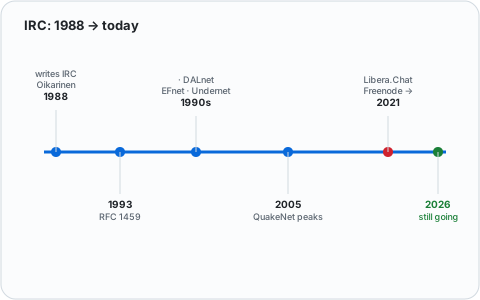
Very little software written for the 1980s internet is still running, let alone in daily use by the projects that build the modern web. IRC is the exception. Here is how a summer project at a Finnish university became infrastructure that outlived most of what came after it.
1988: a summer project in Oulu
In August 1988, Jarkko Oikarinen ("WiZ") was working at the University of
Oulu in Finland. He wanted something better than the multi-user talk program
running on a local bulletin board, OuluBox — something where many people could
type into the same conversation at once. What he wrote was Internet Relay
Chat: servers relaying lines of text between clients, conversations organised
into named channels prefixed with #.
The design spread first to other Finnish universities, then across the academic internet. By 1990 IRC had jumped to the United States and beyond. The protocol was simple enough to implement anywhere and open enough that anyone could run a server — the two properties that would define everything that followed.
1991: IRC reports the news
IRC's first brush with history came in 1991. During the Soviet coup attempt in August, with traditional communication channels cut, users inside and outside the USSR relayed live updates over IRC. The same happened during the Gulf War. For a moment, a university chat system was one of the few real-time windows into events as they unfolded — a pattern the internet would repeat for decades, but which IRC got to first.
The protocol was formally written down in May 1993 as RFC 1459, by Oikarinen and Darren Reed.
The 1990s: growth and the great splits
Success brought the thing every growing online community eventually faces: disagreements about governance, and the technical capacity to act on them by splitting. IRC's open design made forking a network not just possible but almost routine, and the 1990s were defined by it:
- EFnet ("Eris-Free network") emerged from the original network in 1990 after a fight over which servers to trust, and became the dominant network of the early-to-mid 90s. It's still running, still without services.
- Undernet (1992) split off with new ideas about server linking and channel management, introducing the X service.
- DALnet (1994) made the move that shaped every network after it: it introduced NickServ and ChanServ — registered, password-protected nicknames and channels. The idea that you could own a nick, which most networks now take for granted, started here.
- IRCnet (1996) formed when European administrators broke from EFnet, taking much of the continent's user base with them. It remains one of the largest networks, especially in northern Europe.
- QuakeNet (1997) rode the explosion of online gaming, built around Quake clans, and climbed toward becoming — for a time — the largest chat network in the world.
These five, with the lineup shifting over time, became known as the Big Four (the count was always a bit flexible). Together they carried the bulk of a rapidly growing user base.
The 2000s: the peak, and the slide
The early 2000s were the high-water mark. Total IRC usage reached into the millions of concurrent users — by some counts around 10 million across all networks in 2004–2005. The single highest figure ever recorded for one network came on 8 February 2005, when QuakeNet hit 243,394 simultaneous users.
That was the top. The descent began almost immediately, and it was steep: IRC lost roughly 60% of its users between 2003 and 2012. People left for web forums, then for social media — Facebook, Twitter — then later for Slack and Discord. The mass audience that had made IRC feel like the place to be online simply went elsewhere.
But not everyone left, and the people who stayed concentrated around one thing in particular: open source. A network founded in the late 1990s for free-software communities — eventually called Freenode — bucked the trend entirely. While the gaming and general-chat networks shed users, Freenode grew, quadrupling in size to pass 80,000 concurrent users by 2012, on its way to around 90,000. It became the default home of nearly every open-source project's channel. If you contributed to free software, you were on Freenode.
2021: the Freenode collapse
And then, in three weeks in the spring of 2021, Freenode destroyed itself.
The full story is its own article, but in brief: a holding company that had been sold years earlier, under terms hidden from the volunteer staff, was used to assert ownership over the network. On 19 May 2021, the entire volunteer staff resigned and, the same day, founded Libera.Chat — structured as a Swedish nonprofit specifically so no individual could ever own it. The new Freenode management accelerated its own collapse by seizing communities' channels and then wiping the entire registration database.
What followed was the fastest mass migration in IRC history. Ubuntu, the FSF and GNU, Wikimedia, Arch, Gentoo, KDE, PostgreSQL and over a thousand other projects relocated to Libera.Chat within weeks — keeping their channel names, their bots, and their culture intact, because an open protocol let them. The whole open-source world changed which address it connected to, and otherwise carried on.
It was simultaneously the worst governance failure in IRC's history and the clearest demonstration of why the protocol's openness matters.
2026: stable, not shrinking
Which brings us to now. IRC in 2026 is not the mass medium it was in 2004, and it never will be again. But it is no longer declining, either — the numbers have been flat for years. The top networks together hold well over 150,000 concurrent users. Libera.Chat leads at around 31,000, the de-facto home of open source; the survivors of the old era — OFTC, Undernet, IRCnet, EFnet, DALnet — are all still running.
And the protocol is still being developed: the IRCv3 working group keeps extending it (a WebSocket transport and message threading landed as recently as February 2026), modern servers like Ergo ship regular releases, and new clients keep appearing. There are channels that have now run continuously for more than three decades — older than most of the people typing in them.
Not bad for something a student wrote one summer to replace a BBS chat program.