The big IRC networks in 2026: a connect-ready list with server addresses
Updated August 10, 2026
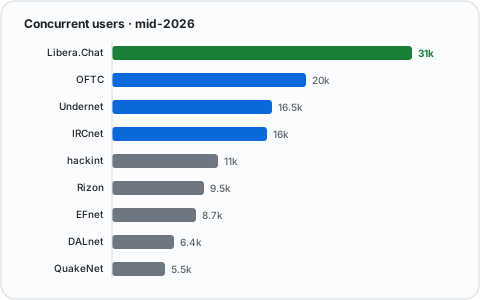
There are something like 500 public IRC networks still running. You do not need 500. You need maybe ten, and realistically you need the two or three that host the communities you care about. This page is the shortlist, ordered roughly by size, of the largest IRC networks still active: the networks with enough people to have a conversation in, with the exact address you type into a client and a link to each network's own homepage.
The user and channel counts below are pulled from netsplit.de's most recent crawl (late June 2026) and rounded — they wobble by a few hundred hour to hour, so treat them as "what size is this, roughly" rather than gospel. Concurrent-user counts also undersell a network: far more unique people pass through a busy channel in a day than are ever connected at one instant.
One rule before you pick a network: you don't, really. You follow a community. The channel you want decides the network for you — so if you're here to join a specific project, skip the table and read how to find the right channel first. The table is for when you want to know what's out there.
The shortlist
All addresses below take TLS on port 6697 unless noted. Plaintext on 6667 exists almost everywhere too, but there is no reason to use it — turn on TLS.
| Network | Users | Channels | Server address | Focus | Site |
|---|---|---|---|---|---|
| Libera.Chat | ~31,000 | ~22,000 | irc.libera.chat |
Free & open-source software | libera.chat |
| OFTC | ~20,000 | ~4,000 | irc.oftc.net |
FOSS; Debian, Tor | oftc.net |
| Undernet | ~16,500 | ~5,600 | irc.undernet.org |
General chat, oldest "Big Four" survivor | undernet.org |
| IRCnet | ~16,000 | ~9,200 | open.ircnet.net |
General; strong in N. Europe | ircnet.info |
| hackint | ~11,000 | ~2,000 | irc.hackint.org |
Hackers, CCC, security | hackint.org |
| Rizon | ~9,500 | ~6,600 | irc.rizon.net |
Anime, fansubs, general | rizon.net |
| EFnet | ~8,700 | ~5,600 | irc.efnet.org |
The original; no services | efnet.org |
| DALnet | ~6,400 | ~3,400 | irc.dal.net |
General; invented NickServ | dal.net |
| freenode | ~5,000 | — | irc.freenode.net |
Shadow of the old network (see below) | freenode.net |
| QuakeNet | ~5,500 | ~5,700 | irc.quakenet.org |
Gaming heritage; European | quakenet.org |
| GameSurge | ~1,800 | ~1,400 | irc.gamesurge.net |
Gaming communities | gamesurge.net |
| EsperNet | ~1,400 | ~1,700 | irc.esper.net |
Gaming, Minecraft, tech | esper.net |
| Snoonet | ~1,200 | ~5,600 | irc.snoonet.org |
Reddit communities, general | snoonet.org |
| tilde.chat | ~700 | ~300 | irc.tilde.chat |
Tildeverse, pubnix, indie | tilde.chat |
That covers the great majority of public IRC activity in 2026. Everything below the table is detail.
The networks worth a paragraph
Libera.Chat — where open source lives
The largest network and the de-facto home of free software. If a project has an official IRC channel today, the odds are overwhelming it is here: Ubuntu, Debian, Arch, Gentoo, Python, PostgreSQL, KDE, the IRCv3 working group, and thousands more. Founded in May 2021 by Freenode's former staff after the takeover, and structured as a Swedish nonprofit so it can't happen again.
A few policies actually affect you:
- registration needs a working email,
- VPN/Tor is restricted for unregistered users,
- and bots, including LLM-driven ones, need channel-operator permission to join.
Help lives in #libera, full walkthrough: the Libera.Chat guide.
OFTC — the other FOSS network
Smaller, quieter, older in spirit. Run under Software in the Public Interest,
long associated with Debian and the Tor Project. Some projects deliberately
keep their channels here rather than on Libera, and a few run on both. If a
project's docs point you at irc.oftc.net, this is why.
Undernet & IRCnet — the surviving giants of the old era
Both are descendants of IRC's first big split-ups and both are still, remarkably, among the largest networks running. Undernet (1992) is general-purpose and uses the X service for channel management instead of ChanServ; it remains a heavyweight, especially outside the FOSS bubble. IRCnet (1996, forked from EFnet by European admins) is strongest in northern Europe — for Swedish and Finnish users this is often where the decades-old channels still are. Like EFnet, IRCnet has no nickname services; channel control is protocol-level only, with ALIS for channel search.
hackint — the hacker scene's network
The network of the European hacker community, tightly bound to the Chaos Computer Club and its events. Conference channels, security research, CTF teams. Punches well above its size in influence.
EFnet — IRC with nothing added
The direct continuation of the original 1988 network, and proudly still without services: no NickServ, no ChanServ, no registration of anything. Your nick is yours while you're connected; your channel is yours while your ops are present. It is the protocol as designed, running in 2026 — chaotic by reputation, calmer in practice.
DALnet — the network that invented registration
DALnet (1994) gave IRC the NickServ/ChanServ model that almost every other network later copied — the reason you can own a nick at all. Mid-sized and famously the "friendly" network today.
QuakeNet — gaming's old capital
Born from Quake clans in 1997, QuakeNet was the largest IRC network in the world at its 2005 peak, with over 240,000 simultaneous users. The esports crowd has long since moved to Discord, and the network now runs around 5,500 — but it never closed, and a loyal European gaming community remains. Its services are Q and L, not NickServ.
The full rise-and-fall is its own story: whatever happened to QuakeNet.
Rizon — anime and everything around it
The cultural home of anime and fansub communities, with a healthy spread of general and tech channels alongside. Runs Anope services, so registration works much like Libera.
freenode — here for the record
The freenode that mattered is gone. After the 2021 staff exodus, the name
relaunched on new software with none of the old data migrated — every nick
and channel registration was wiped. What runs at irc.freenode.net today is a
small, largely empty network sharing a name with a dead one. If old
documentation sends you here, the community you're looking for almost certainly
moved to Libera.Chat or OFTC years ago.
The long tail is real
Below this list are hundreds more networks: national and language communities (some with channels larger than anything in the table above — you've just never heard of them), retro-computing nets, single-community servers, and the self-hosted Ergo instances that have made running your own little network fashionable again. If you want to go spelunking, netsplit.de and IRC Driven both crawl and rank the whole field, and our guide to finding channels covers searching across networks at once.
Connecting, in three lines
Whatever you picked:
- Open a client (or webchat to skip installing).
- Connect to the server address from the table, TLS, port 6697.
/join #channelname— or the network's help channel (#help,#libera,#oftc…) if you're not sure where to go.
And remember identities are per-network: registering your nick on Libera does nothing on Rizon. Register everywhere you intend to stay.