QuakeNet in 2026: is it still running, and what happened to it?
Updated June 28, 2026
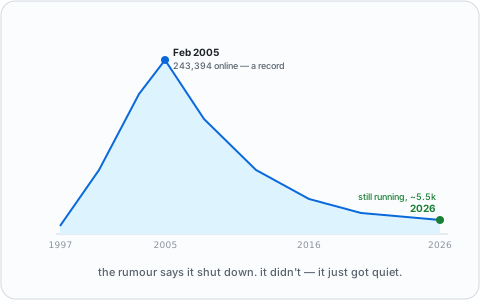
On 8 February 2005, an IRC network built by Quake players recorded 243,394 people connected at the same time. That is the highest concurrent-user count any single IRC network has ever reached, before or since. For a stretch in the mid-2000s, QuakeNet wasn't just the biggest IRC network — it was, by that measure, the biggest real-time chat network in the world.
Today it runs around 5,500.
So what happened? The short answer is "the same thing that happened to all of gaming's chat infrastructure," but QuakeNet's version is specific, and there's a persistent myth to clear up first.
No, it didn't close
If you search around, you'll find confident claims that QuakeNet "officially closed in early 2024." This is wrong. It comes from low-quality auto-generated articles, and it is worth correcting plainly, because it spread.
As of mid-2026 QuakeNet is online and crawled daily, running roughly 5,500 users across about 5,700 channels. Services and webchat work. The events are still happening. It is much smaller than it was. It is not gone.
With that out of the way — the actual history.
Where it came from (1997)
QuakeNet was founded in 1997 by two admins, Garfield (Henrik Rasmussen, in Denmark) and Oli (Oli Gustafsson, in Sweden), as a home for their countries' QuakeWorld channels. The existing big networks of the day — EFnet, IRCnet, Undernet — were crowded and not especially welcoming to a flood of gaming clans, so the Quake crowd built its own haven.
The timing was perfect. Online multiplayer gaming was exploding, clans needed somewhere to organise matches and trash-talk, and a dedicated network with a gaming culture was exactly the right container. By 1998 the developers Mag and Madhacker had built an early version of Q, the channel and authentication service that became QuakeNet's signature — and the network was off.
The climb to number one
Through the late 1990s and early 2000s QuakeNet rode the gaming wave straight up. It spread far beyond Quake itself — Counter-Strike clans, general gaming, then general everything, because that's what happens when a network gets big enough. It joined the ranks of the largest networks and then passed them, becoming part of, and then the leader of, the group traditionally called the Big Four.
The peak — 243,394 simultaneous connections in February 2005 — came at the high tide of IRC generally. Total IRC usage at the time was somewhere around ten million users across all networks (the high-water mark in IRC's history). QuakeNet was the single biggest piece of it.
The fall
Then the same slide that hit all of IRC hit QuakeNet, and a second wave hit it specifically.
The general decline is well documented: IRC as a whole lost about 60% of its users between 2003 and 2012 as people moved first to web forums and social media, then to purpose-built chat. But QuakeNet's collapse was steeper than the average because its core audience — gamers — got served directly by new tools in a way that IRC couldn't match:
- Voice changed everything. Ventrilo, TeamSpeak, then Mumble gave clans push-to-talk voice that text IRC simply wasn't. For coordinating a match, that's not a nice-to-have.
- Then Discord ate the rest. From 2015, Discord offered gaming communities voice, video, persistent message history, images, mobile apps, and a one-click invite link — the entire package, free, in one app. For the exact use case QuakeNet was built for, Discord was strictly better on every axis a clan cared about.
- Gaming culture moved on from Quake. The titles and clans that defined the network aged out, and the generation that replaced them never had an IRC habit to begin with.
The numbers track the story: over 100,000 regular users as late as 2010, around 12,000 by 2020, and the ~5,500 it runs today. A network that was once the world's largest chat platform contracted by more than 97% from its peak.
What's actually left
A real community, just a small and specific one. The people still on QuakeNet are there because they've been there for twenty years and the network does what they need. It still:
- Runs its bespoke services — Q for authentication and channel management (first-come-first-served, with no separate nickname-protection service), L, S ("SpamScan") for abuse control, and D for channel statistics.
- Hosts its own qwebirc webchat, which the QuakeNet team wrote, so you can connect from a browser without installing anything.
- Runs events — trivia nights, competitions, and anniversaries; the network marked its 27th birthday in 2024 with the veterans still showing up.
Connecting today
If you want to see it for yourself:
- Server:
irc.quakenet.org, port 6697 with TLS. - Services: authenticate with Q —
/msg Q@CServe.quakenet.org HELLOto create an account. Note this is Q, not NickServ; QuakeNet does the authentication model its own way. - Help:
#help, and the guides on quakenet.org itself.
The takeaway
QuakeNet is the clearest single illustration of what happened to IRC: a network that did one thing brilliantly, got overtaken by purpose-built tools that did that specific thing better, and contracted hard — but didn't vanish, because the people who valued what remained kept it running. It's the whole "is IRC dead" question compressed into one network's story. The mass left. The floor held.
243,394 down to 5,500 is a brutal chart. It's also still a chart with a line on it, twenty-one years later.