Is IRC dead in 2026? The actual numbers, not the vibes
Updated August 10, 2026
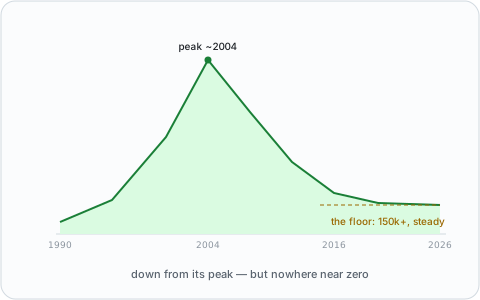
Someone declares IRC dead roughly once a year, and has done since about 2005. It makes a good headline and it is, in the narrow sense the writer means, true: the masses left a long time ago. But "the masses left" and "it's dead" are different claims, and the gap between them is the whole story.
So let's do this with numbers instead of vibes.
What the numbers actually say
The peak is not in dispute. Around 2004–2005, total IRC usage was in the millions of concurrent connections, and a single network — QuakeNet — hit 243,394 simultaneous users on 8 February 2005, the highest figure ever recorded for one network. Then the slide: IRC lost roughly 60% of its users between 2003 and 2012, first to web forums and social media, later to Slack and Discord. That decline is real and nobody serious argues otherwise — it's the descent traced in the full history of IRC.
Here is the part the obituaries skip. The slide stopped. In mid-2026, the top hundred networks together hold well over 150,000 concurrent users, and that number has been broadly flat for years — not still falling, flat. The largest network, Libera.Chat, alone carries around 31,000 users across 22,000 channels. OFTC holds ~20,000. Undernet and IRCnet, both survivors of the 1990s, still run ~16,000 each. The decline didn't continue to zero. It hit a floor and the floor turned out to be solid.
Why a floor formed
Because the people left on IRC are the people for whom its supposed weaknesses are actually features:
- Open-source projects. When a project's docs say "ask in #project," they usually mean IRC. The official support and development channels for most major distributions, languages, and tools live on Libera or OFTC. These communities didn't stay out of nostalgia; they stayed because an open protocol can't be bought, shut down, or pivoted out from under them — a lesson the Freenode collapse taught in the harshest possible way, when tens of thousands of channels relocated networks in weeks and kept working.
- Operations people. When infrastructure is on fire, the chat system that depends on almost nothing is the one that still works. IRC runs in a terminal, over SSH, on a connection held together with tape.
- Communities with decades of continuity. Channels that have run continuously for 25+ years have outlived more platforms than most people have ever signed up for. They're not migrating to the chat app of the month.
- People who want chat without an account. No phone number, no email (unless you choose to register), no feed, no ads, no data mining.
"Dead" usually means "I personally don't use it"
Most "IRC is dead" takes are really saying something narrower: the people I chat with aren't there. Which is fine and probably accurate. But it's a statement about the writer's social graph, not about the protocol.
Protocols aren't products. A product needs growth or it dies — no new users, no revenue, lights off. A protocol needs only maintainers and users, and by that measure IRC is conspicuously alive in 2026:
- Server software is actively developed — Ergo ships regular releases, UnrealIRCd added post-quantum crypto, Solanum and InspIRCd are maintained.
- The IRCv3 working group keeps extending the protocol — message tags, server-side history, and as recently as February 2026, a WebSocket transport and message threading.
- New clients keep appearing and finding users: the Rust-based Halloy, the mobile-first goguma, and a from-scratch Swift client, Mango, relaunching in 2026.
- Networks have functioning governance — Libera updated its bot policy in 2026 specifically to deal with the LLM-bot era.
None of that is what a dead protocol looks like.
The honest catch
IRC genuinely isn't for everyone, and pretending otherwise does no one any favours. Out of the box it has no voice, no video, no embedded media, and — on the big traditional networks — no message history: disconnect and you miss what was said. That last one is the real friction for newcomers, and the classic fixes (a bouncer, a cloud client, or a modern network with server-side history) are an extra step that Discord simply doesn't ask of you. If you want a place where your group of twelve friends shares memes and hops on voice, IRC is the wrong tool and that's fine.
So should you bother?
If your people are already somewhere else and happy, no — there's no prize for switching. But if you contribute to open source, work in operations, value a protocol no company can take away from you, or just want to see what real-time chat looked like before it was monetised, IRC isn't a museum exhibit. It's working infrastructure that happens to be older than the web.
The test costs two minutes: read what IRC is and join a channel. Worst case, you close the tab and the obituary writers were right about you specifically.
Quick answers
Is IRC still used in 2026?
Yes — over 150,000 concurrent users across the top hundred networks, a number that's been flat for years, not falling.
Is IRC still a thing, or is it a museum piece?
Working infrastructure, not a museum piece: open source projects run their support channels on it daily, and server software is still under active development.
Does IRC still exist?
Yes, and it never stopped — the "it shut down" claims usually confuse IRC itself with a single network like the old Freenode, which split into Libera.Chat rather than disappearing.
Is mIRC still alive?
Yes — mIRC shipped version 7.84 in June 2026, still under active development after thirty-one years. See mIRC in 2026.
Numbers in this article are drawn from netsplit.de network crawls current to mid-2026 and rounded; concurrent-user figures necessarily undercount the unique people who pass through over a full day.